
Teaching Experience
I teach diverse student populations across disciplines, degree levels, class, geography, race, ethnicity, culture, age, and gender in formal and informal education settings, from public to professional and higher education.
I am currently teaching sustainability studies and engineering studies at UNM, and I am serving on multiple Ph.D. dissertation and master’s thesis committees at UNM in the Departments of Anthropology, Earth and Planetary Sciences, and Geography and Environmental Studies.
I am currently teaching environmental science and anthropology at Southwestern Indian Polytechnic Institute (SIPI), a tribal community college, where I serve as the lead instructor of the Environmental Science Program, and the PI of the Bureau of Indian Affairs Environmental Stewardship grant, which we used to kickstart an air quality citizen science hub and develop a water science certificate program at SIPI.
I also have a breadth of community education experience reporting back research results, science and risk communication, and research translation among Indigenous community partners in the Community Engagement Core and Research Translation Core of the UNM METALS Superfund Research Program, and among Hispano/Nuevomexícano community partners through the Community Engagement Core of the UNM CHANGES Center, which links climate change and extreme weather events (e.g., wildfires) to community health outcomes (e.g., cancer).
Teaching Philosophy
My philosophy of teaching is rooted in my experience in the Anthropology and Education Program at Teachers College, Columbia University. As a former teaching assistant for the graduate course, “Race, Class, and Schooling: Ethnographic Approaches,” I worked with Professor Raymond McDermott modeling ethnographic approaches to education as a method for understanding problems of inequality and injustice. We took cultural accounts of human agency that express differences in particular historical conditions, and the situated nature of learning. In the case of student failure, instead of asking the psychological and pathological question of what is wrong with the student, we asked the sociocultural question of what conditions made the student’s failure possible. Rather than follow the commonplace student deficit theory of learning, we reflexively turned questions of failure back toward deficits in curricula, pedagogy, and institutions of education.
Thinking of Jean Lave’s educational research on situated learning and apprenticeship in critical ethnographic practice, I introduce collaborative case study research as a heuristic method for teaching students ethnographic approaches to engineering, environmental science, and sustainability. Empirical case studies bring together story-driven science, place-based, and student-centered research projects. As my students become proficient in problem-oriented case study research, they begin to analyze and explain the relationship between diverse environmental sciences and forms of environmental health governance, and critically analyze different stakeholder perspectives, discourse, and actions.
Beyond my disciplinary background in anthropology, I have additional teaching experience in the interdisciplinary field of science and technology studies (STS). At the heart of my teaching philosophy and practice is a transdisciplinary approach that leverages intellectual differences and diversity to better come to terms with “the public and its problems,” in John Dewey’s sense. Inspired by the historian of biology Evelyn Fox Keller, this pedagogical orientation toward epistemological pluralism opens up the possibilities for many different ways of knowing to enrich students’ collective educational experiences.
Academic Teaching Positions
Aug. 2024- present / University of New Mexico, Albuquerque, NM / Lecturer, School of Engineering
Aug. 2024- present / Southwestern Indian Polytechnic Institute (SIPI), Albuquerque, NM / Instructor, Environmental Science Program
Aug. 2023- present / University of New Mexico, Albuquerque, NM / Lecturer, Department of Geography and Environmental Studies, Sustainability Studies Program
Aug. 2023- present / University of New Mexico, Albuquerque, NM / Affiliated Faculty, Department of Anthropology, Sociocultural and Linguistic Anthropology Program
Aug. 2021- July 2024 / Southwestern Indian Polytechnic Institute (SIPI), Albuquerque, NM / Adjunct Instructor, Department of Advanced Technical Education, Environmental Science Program
Sep. 2020- Dec. 2020 / New Mexico Institute of Mining and Technology, Socorro, NM / Lecturer, Department of Communications, Liberal Arts, and Social Sciences (CLASS)
Aug. 2016- May 2017 / Rensselaer Polytechnic Institute, Troy, NY / Teaching Assistant, Department of Science and Technology Studies (STS)
Sep. 2014- Dec. 2014 / Teachers College, Columbia University, New York, NY / Teaching Assistant, Anthropology and Education Program
Dec. 2017 – May 2017 / Teaching Assistant, Sustainability Education and EcoEd Research Group, Rensselaer Polytechnic Institute, Troy, NY.
Aug. 2016 – May 2017 / Teaching Assistant, “Environment and Politics,” Rensselaer Polytechnic Institute, Troy, NY
Sept. 2014 – Dec. 2014 / Teaching Assistant, “Race, Class, and Schooling: Ethnographic Approaches,” Teachers College, Columbia University, New York, NY
Undergraduate and Graduate Courses Taught
- ANTH 1115 Introduction to Anthropology (SIPI, Summer 2025 and Fall 2025)
- ENVS 2120 Tribal Environmental Management and Planning (SIPI, Spring 2025)
- ENVS 2110 Contemporary Issues in Environmental Science (SIPI, Fall 2022 and Spring 2025)
- ENVS 1110 Environmental Science I + Lab (SIPI, Fall 2024)
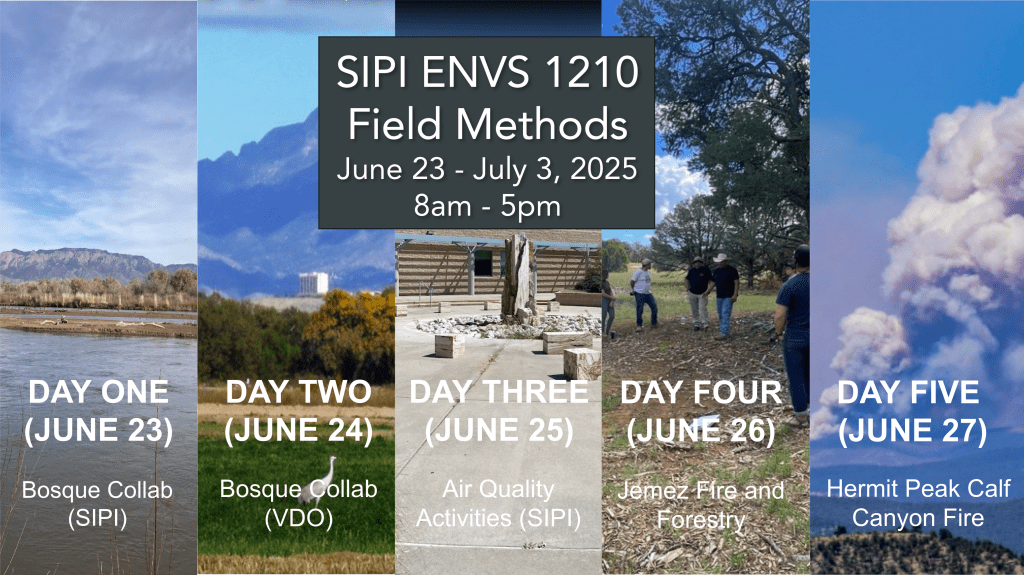
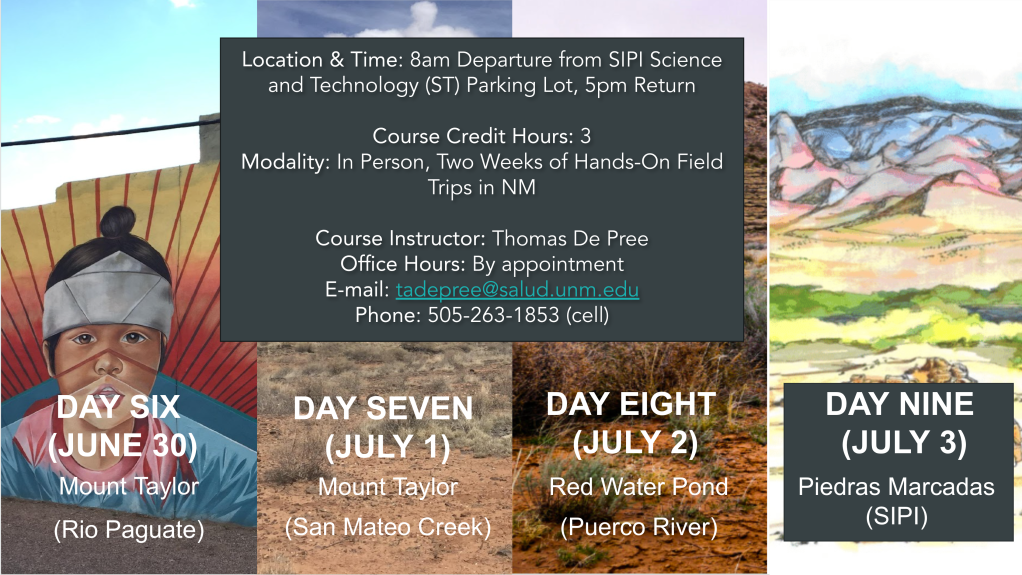
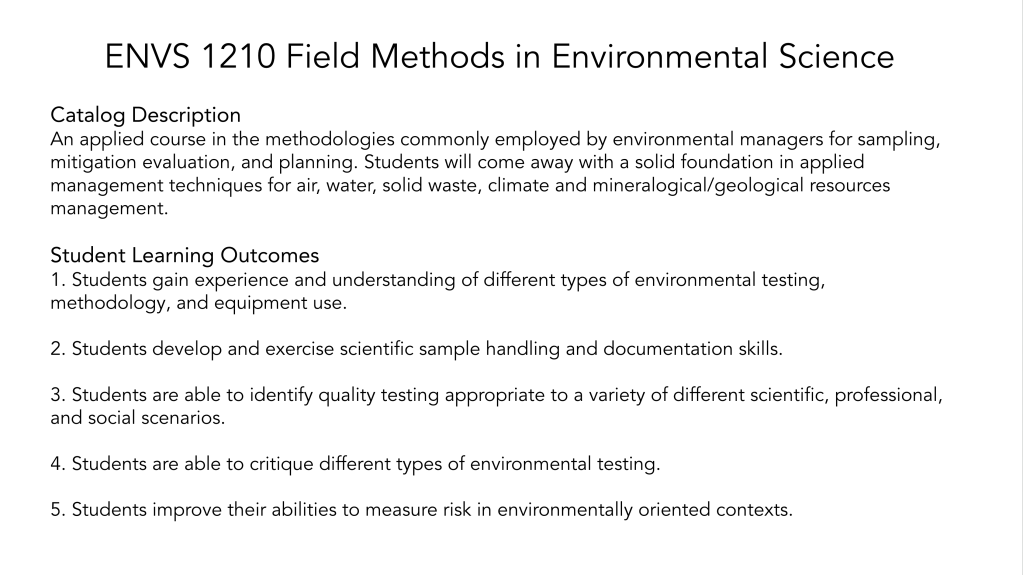
- ENVS 1210 Field Methods in Environmental Science (SIPI, Summer 2025)
- ENVS 290 Indigenous Environmental Justice (SIPI, Summer 2022)
- ENVS 1310 Environmental Regulations (SIPI, Spring 2021, Fall 2024, Fall 2025)
- FYEX 1110 First Year Experience: Engineer, Design, Explore, Build (UNM, Fall 2025)
- HUM 389 Atomic America (NMT, Fall 2020)
- ITSF 5007 Race, Class, and Schooling: Ethnographic Approaches (TCCU, Fall 2015)
- STSS 4280 Sustainability Education (RPI, Spring 2016)
- SUST 1134 Introduction to Sustainability Studies (UNM, Fall 2023 and Spring 2024)
Example Syllabi
See the digital essay, Afterlife of Atomic America, for the Disaster STS Network about teaching the General Education history course, “Atomic America,” at New Mexico Tech (De Pree, 2020): https://disaster-sts-network.org/content/afterlife-atomic-america-0/essay
 Thomas De Pree - Anthropology & Environmental Health Sciences