
Thomas De Pree, Ph.D.
Research Faculty, University of New Mexico (UNM) & Teaching Faculty, Southwestern Indian Polytechnic Institute (SIPI)

Selected Publications:
- De Pree TA. The politics of baselining in the Grants uranium mining district of northwestern New Mexico. J Environ Manage. 2020 Aug 15;268:110601. doi: 10.1016/j.jenvman.2020.110601. Epub 2020 May 14. PMID: 32510424.
- De Pree, Thomas. 2024. “‘Origin Stories of the ‘Grants Uranium District’ in Northwestern New Mexico: Archives, Memoirs, and Exploratory Boreholes in the Production of Geological Regions.” Engaging Science, Technology, and Society 10(3): 37–64.
https://doi.org/10.17351/ests2023.2323. - Keyanna, Teracita, Thomas De Pree, Chris Shuey, Kirena E. Y. Tsosie, Mallery Quetawki, and Cheryl Jim. “What Is “Restorative Justice” after the Church Rock Uranium Spill?” Journal of Disaster Studies 2, no. 1 (2025): 17-45. https://muse.jhu.edu/article/971161.
- Powell, D. E., & De Pree, T. A. (2025). The Promises and Pitfalls of “Clean Energy Transitions”: Introduction to the Special Issue. Environment and Society, 16(1), 1-12. Retrieved Nov 5, 2025, from https://doi.org/10.3167/ares.2025.160101
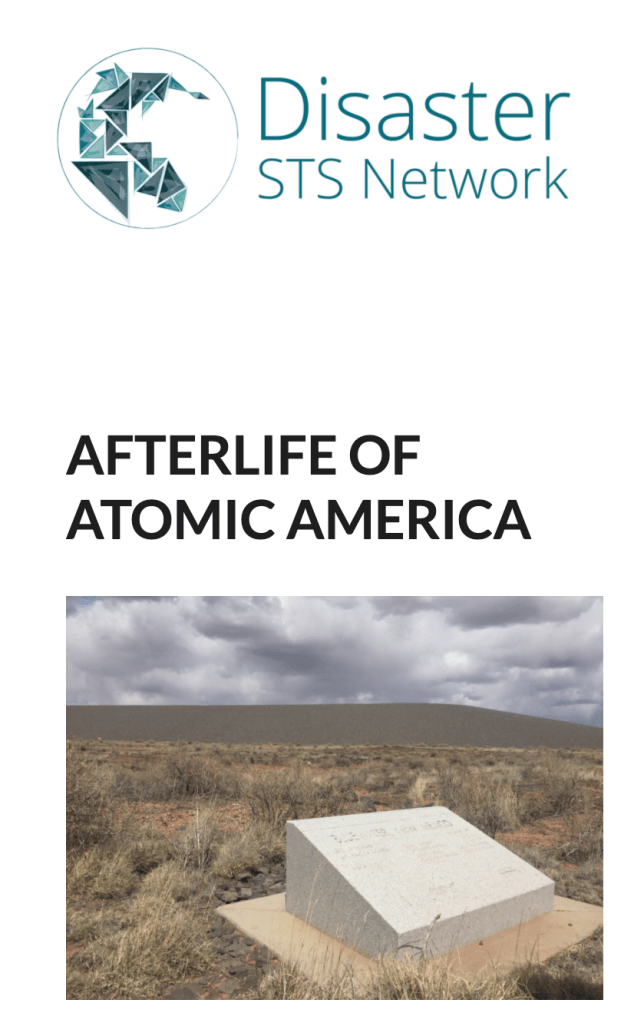
- See the digital essay, “Afterlife of Atomic America,” for the Disaster STS Network about teaching the remote General Education history course, “Atomic America,” at New Mexico Tech (De Pree, 2020): https://disaster-sts-network.org/content/afterlife-atomic-america-0/essay

Discipline: Sociocultural Anthropology
Methods: Ethnographic; Environmental Health Sciences
Areas of Interdisciplinary Experience: Political Ecology; Native American and Indigenous Studies; Science and Technology Studies (STS)
Education
- Ph.D., Science and Technology Studies, Rensselaer Polytechnic Institute (August 2019)
- M.S., Science and Technology Studies, Rensselaer Polytechnic Institute (May 2019)
- M.A., Anthropology and Education, Teachers College, Columbia University (May 2015)
- B.A., Anthropology and Psychology, University of New Mexico (January 2010)
Biosketch
My academic research, teaching, and service are situated in the field of environmental anthropology, which combines ecological and ethnographic research methods to advance knowledge at the intersection of environment and society. I have an interdisciplinary background in the fields of science and technology studies (STS), political ecology, and environmental health sciences.
My past academic scholarship is rooted in community engagement with the Multicultural Alliance for a Safe Environment (MASE)—a regional NGO that coordinates the efforts of five local grassroots groups from the former Grants uranium mining district. Based on over two years of multi-locale ethnographic research on the relationship between local communities, government employees, and transnational mining corporations, my past research examined different stakeholder perspectives, the diverse forms of expertise, and the dense entanglements of science, technology, and politics invested in “reclaiming” abandoned mine lands, “remediating” contaminated sites, and “restoring” the natural and cultural resources of northwestern New Mexico.
My thesis is that the possibility of cleaning up the Grants district hinges on the politics of baselining–a term I introduce to describe the relationship between stakeholders and their competing environmental models and hydrogeological theories; each accounts for a different geological past prior to mining that can be deemed “natural,” as the background against which to measure the anthropogenic impacts from mining.
In my current role in the UNM METALS Community Engagement Core, I aim to advance understanding of how local Indigenous knowledge, history, experiences, and methods can transform population-based health studies aimed at reducing risks from abandoned uranium mines (AUMs) on community land uses, air, water, and health. Through interdisciplinary collaboration with the environmental and biomedical research projects, and with community partners in Laguna Pueblo (K’awaíka) and the Navajo Nation (Diné Bikéyah), we are in the process of co-designing “interventions” to monitor and attenuate environmental exposures.

The UNM Metals Exposure and Toxicity Assessment on Tribal Lands in the Southwest (UNM METALS) Superfund Research Program Center, the first of its kind in the nation, is dedicated to studying the toxic effects of mixed metals and uranium exposure on tribal communities in the Southwest. Funded through the National Institute of Environmental Health Sciences (NIEHS 1 P42 ES025589). The US West is home to more than 4,000 uranium mines and some 160,000 abandoned hard rock mines. About 600,000 Native Americans live within 10 kilometers of the sites. The health effects have been profound, and the center is conducting further research to determine the best methods for remediation of mine waste sites and risk reduction strategies within communities to help curb further exposure to the contaminants.
The Community Engagement Core (CEC) of the UNM METALS Center links impacted communities impacted by abandoned uranium mines (AUMs) with scientists examining how mixed metals exposures affect health and ways to reduce exposure and health risk. The METALS CEC gives residents of the impacted communities on tribal lands and researchers opportunities to develop a common language and understanding of environmental health and traditional ecological knowledge through community-based listening sessions, training programs, and by facilitating community involvement in data collection and interpretation.
contact info: tadepree@salud.unm.edu
 Thomas De Pree - Anthropology & Environmental Health Sciences